
Oral Paper Presentation
Annual Scientific Meeting



Joseph Gunderson, MD
University of Texas Southwestern Medical Center
Dallas, TX
Acute colonic pseudo-obstruction (ACPO) is a rare condition involving non-obstructive colonic dilation without an anatomic cause. Management includes supportive therapy (ST) and interventional treatments, but optimal therapy and predictors of poor outcomes remain unclear. This study aimed to identify factors linked to ST failure and to compare the efficacy of neostigmine (NEO) and decompressive colonoscopy (COL) in ACPO.
Methods:
ACPO cases in patients ≥18 years old were identified using ICD-9/10 codes from January 2014 to June 2024 across 1,238 Banner Health sites. Demographics, clinical features, and treatment data were collected. ST included withdrawal of precipitating factors, bowel rest, prokinetic agents, and nasogastric/rectal tube decompression. Resolution was defined as symptomatic or radiographic improvement or stool passage. Primary outcomes were ST failure and resolution after administration of NEO or COL in ST non-responders. Statistical analysis included Fisher’s exact test, Mann-Whitney U test, and adjusted Cox regression and logistic regression.
Results:
We identified 271 ACPO cases in 217 patients (median age 69 years, 32.5% female, 79.3% non-Hispanic White, median Charlson Comorbidity Index [CCI] 4). Common precipitating factors were electrolyte disturbances (52.4%), narcotic use (42.1%), sepsis (41%), and respiratory failure (37.3%). The median colon diameter was 10.8 cm.
The resolution rate with ST was 27.3%. Temperature < 36 °C (aHR 2.19, P = 0.003), body mass index ≥30 kg/m2 (aHR 1.45, P = 0.014), and Black or African American race (aHR 1.39, P = 0.018) predicted ST failure. Electrolyte disturbances as a precipitating factor was associated with improved ST response (aHR 0.68, P = 0.012).
54.8% of ST non-responders underwent COL while 31% received NEO, with resolution rates of 75.9% and 41%, respectively (aOR 3.48, P < 0.001). Patients receiving COL were older (median age 70 vs. 66, P = 0.032), had higher median CCI (5 vs. 4, P = 0.001), and higher rates of coronary artery disease (31.5% vs. 13.1%, P = 0.009) and congestive heart failure (29.6% vs. 14.8%, P = 0.039).
Discussion:
A vast majority of ACPO patients do not respond to ST and no modifiable risk factors predict further need for interventions. As first-line therapy, COL appears to be more efficacious than NEO despite its use in older patients with more comorbidities. Further studies are needed to identify factors associated with response to COL and NEO in ACPO patients.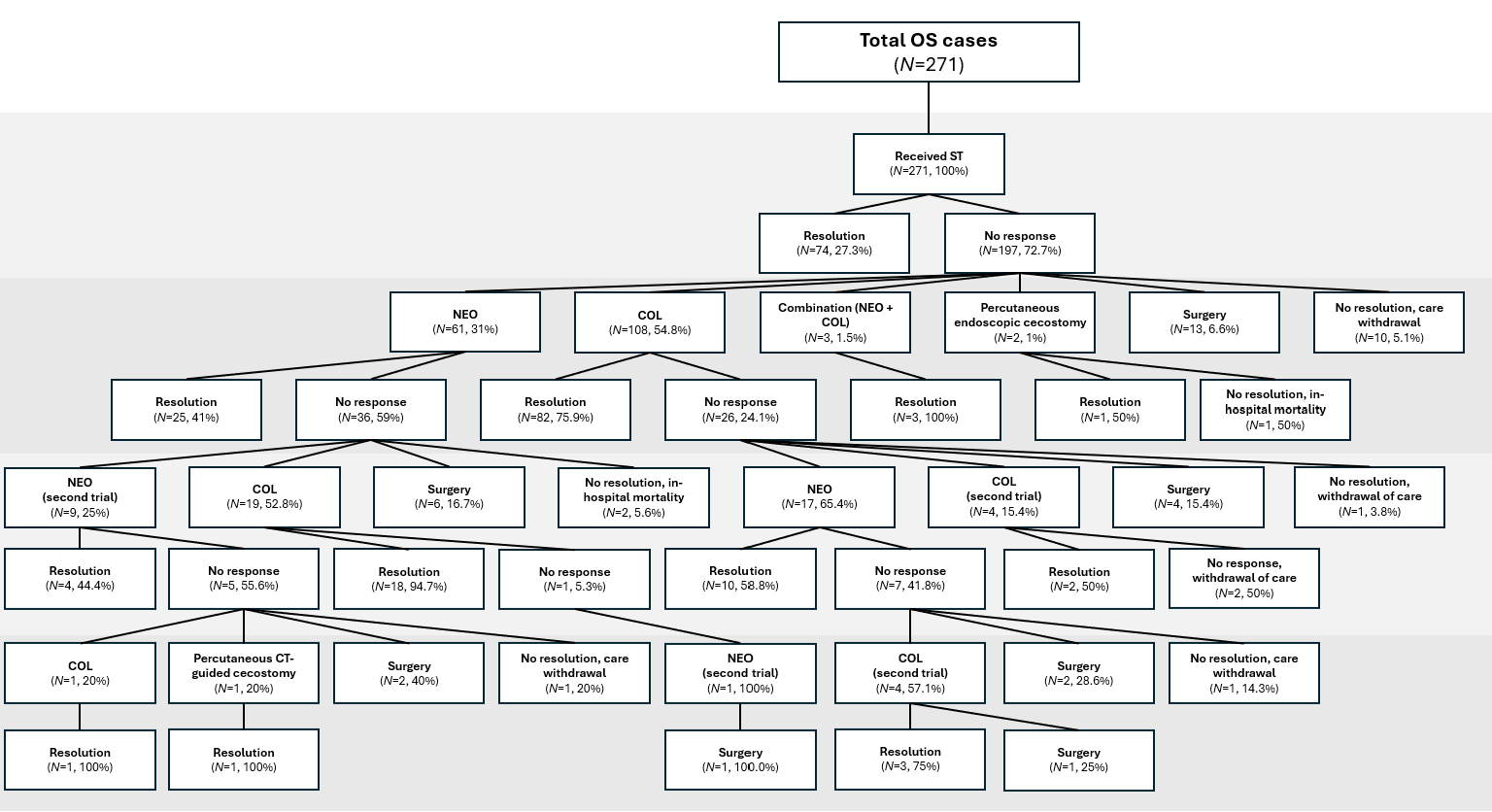
Figure: Figure 1. Overview of treatment and outcomes for patients with acute colonic pseudo-obstruction (ACPO); ST = supportive therapy, NEO = neostigmine, COL = decompressive colonoscopy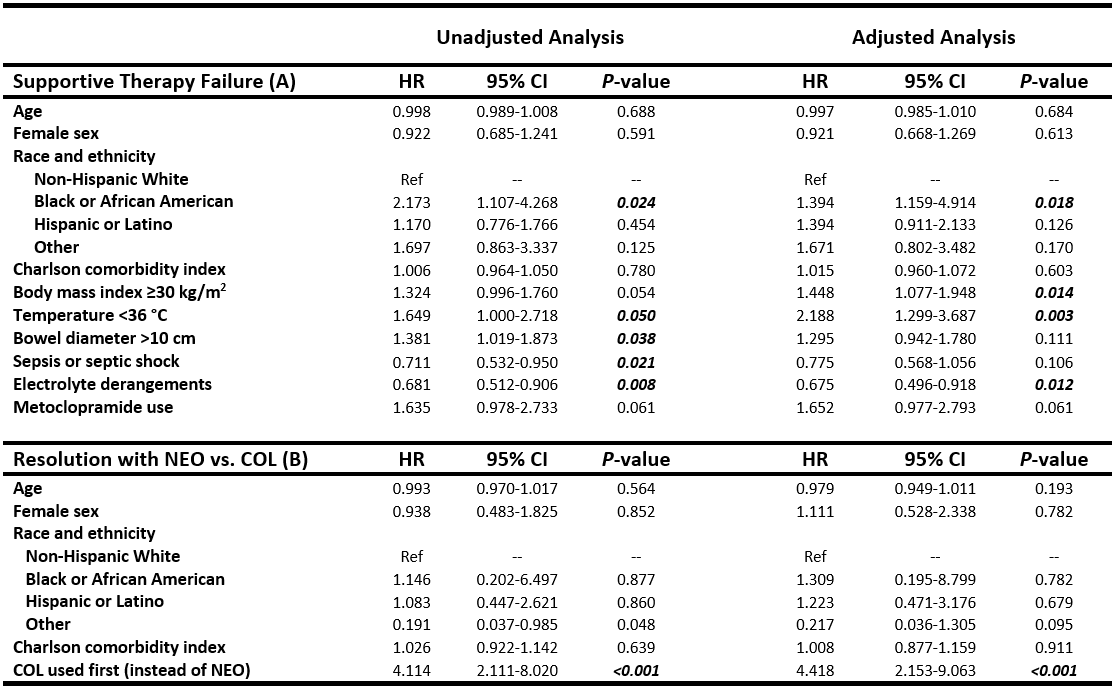
Figure: Table 1. (A) Cox regression analysis identifying predictors of supportive therapy failure, and (B) logistic regression analysis assessing first-line neostigmine (NEO) vs. decompressive colonoscopy (COL) in resolution of acute colonic pseudo-obstruction (ACPO)
Disclosures:
Joseph Gunderson indicated no relevant financial relationships.
Fariba Hossain indicated no relevant financial relationships.
Alisia Gunderson indicated no relevant financial relationships.
David Schaub indicated no relevant financial relationships.
Chiu-Hsieh Hsu indicated no relevant financial relationships.
Sasha Taleban: AbbVie – Grant/Research Support. Boehringer-Ingelheim – Grant/Research Support. Eli Lilly – Grant/Research Support. Janssen – Advisory Committee/Board Member, Grant/Research Support. Pfizer – Grant/Research Support. Takeda – Grant/Research Support.
Joseph Gunderson, MD1, Fariba Hossain, BS2, Alisia C. Gunderson, MD1, David J. Schaub, MD3, Chiu-Hsieh Hsu, PhD4, Sasha Taleban, MD, FACG2, 19, Decompressive Colonoscopy Is Superior to Neostigmine in the Treatment of Acute Colonic Pseudo-Obstruction, ACG 2025 Annual Scientific Meeting Abstracts. Phoenix, AZ: American College of Gastroenterology.