
Endoscopy Video Forum
Annual Scientific Meeting

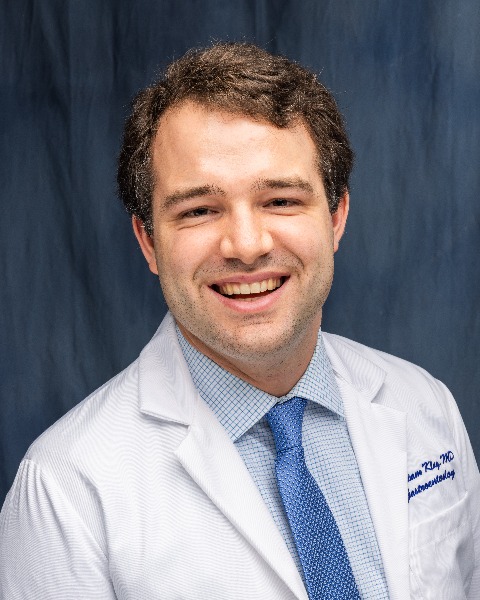
William King, MD
University of Florida
Gainesville, FL
Both esophageal perforation and variceal hemorrhage are life threatening conditions with high mortality. Esophageal rupture was historically managed surgically, although endoscopic therapy has emerged as an alternative.
Case Description/
Methods:
A 55-year-old woman with a history of previously compensated alcohol related cirrhosis presented with hematemesis. A CT angiogram revealed contrast extravasation in the distal esophagus in the portal venous phase. There was no gas in the mediastinum on the initial CT.
She then developed massive hematemesis, hypotension, and tachycardia. She was given ceftriaxone, intravenous pantoprazole, and infusions of octreotide and norepinephrine. After endotracheal intubation, the care team attempted to place a Sengstaken-Blakemore (SB) tube, which coiled in the distal esophagus. On one attempt, the gastric balloon was inadvertently inflated in the esophagus; malposition was confirmed on chest X-ray.
Bedside EGD revealed esophageal varices and a briskly bleeding, large, linear perforation extending from 24 to 36 cm from the incisors. Repeat CT was consistent with hemo-pneumomediastinum.
She was brought urgently to the interventional endoscopy suite. Using an endoscopic suturing device loaded with 2.0 polypropylene suture, two interrupted sutures with 20 total bites were placed in an interrupted fashion, extending from the distal esophagus towards the proximal esophagus. The brisk bleeding subsided as the sutures were placed and the perforation was closed. After cinching the suture, there was excellent tissue approximation and no residual bleeding. We therefore elected not to place an endoluminal stent. The esophagus was filled with water soluble contrast, and a CT scan revealed no extraluminal contrast.
Within 24 hours after the procedure, the patient was weaned off vasopressors and extubated. She spent two weeks on total parental nutrition. A repeat CT esophagram 2 weeks after the procedure again showed no evidence of contrast extravasation. Her diet was advanced, and she now tolerates soft foods.
Discussion:
Even with portal hypertension, active variceal hemorrhage, and a large esophageal perforation, endoscopic suturing can be used to close the perforation and achieve hemostasis. Endoscopic suturing should be considered a viable salvage technique.