68 - Guselkumab Maintenance Dose Regimens in Patients With High Disease Activity and Severity: Subgroup Analysis of Participants With Moderately to Severely Active Crohn’s Disease in the GALAXI Phase 3 Studies
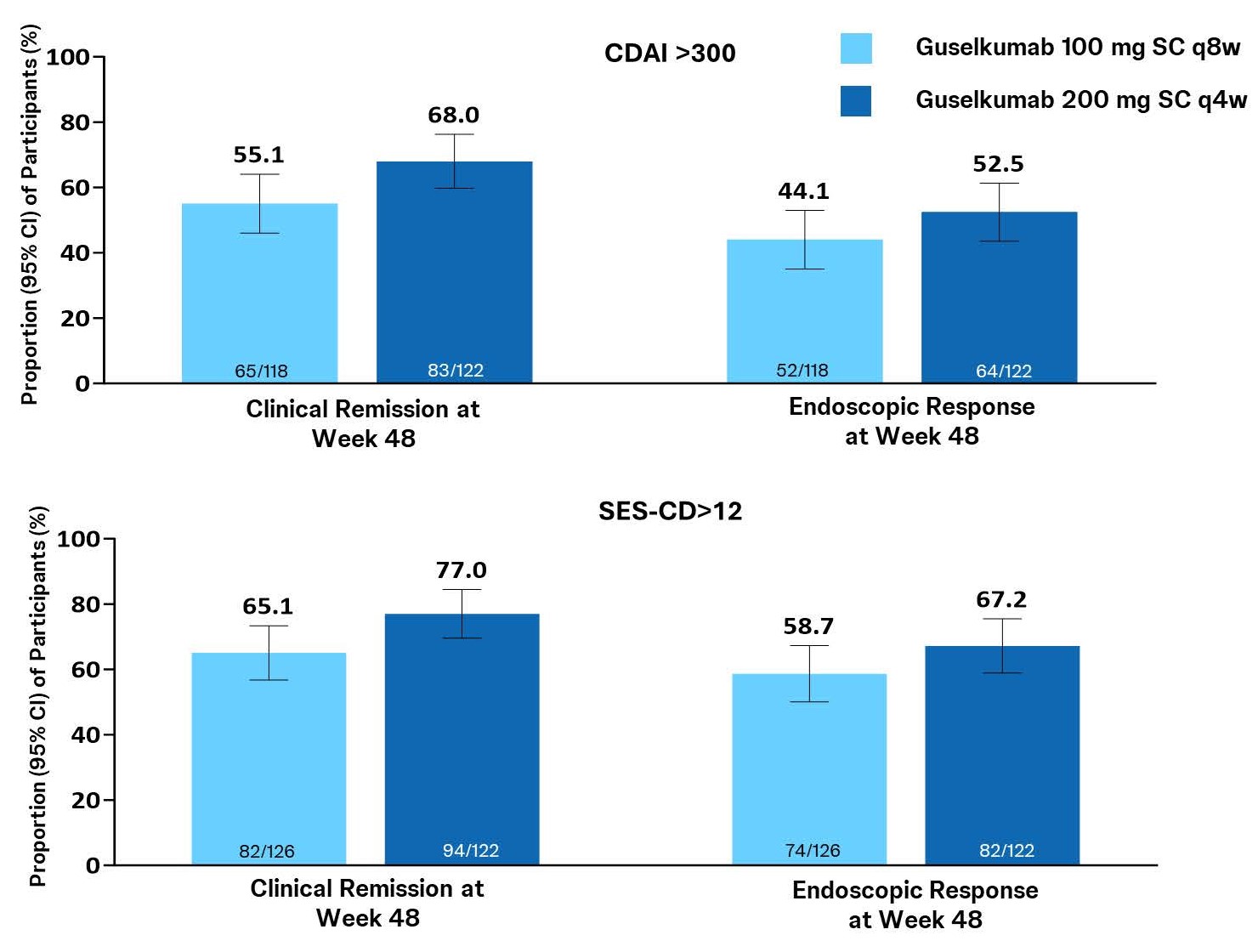
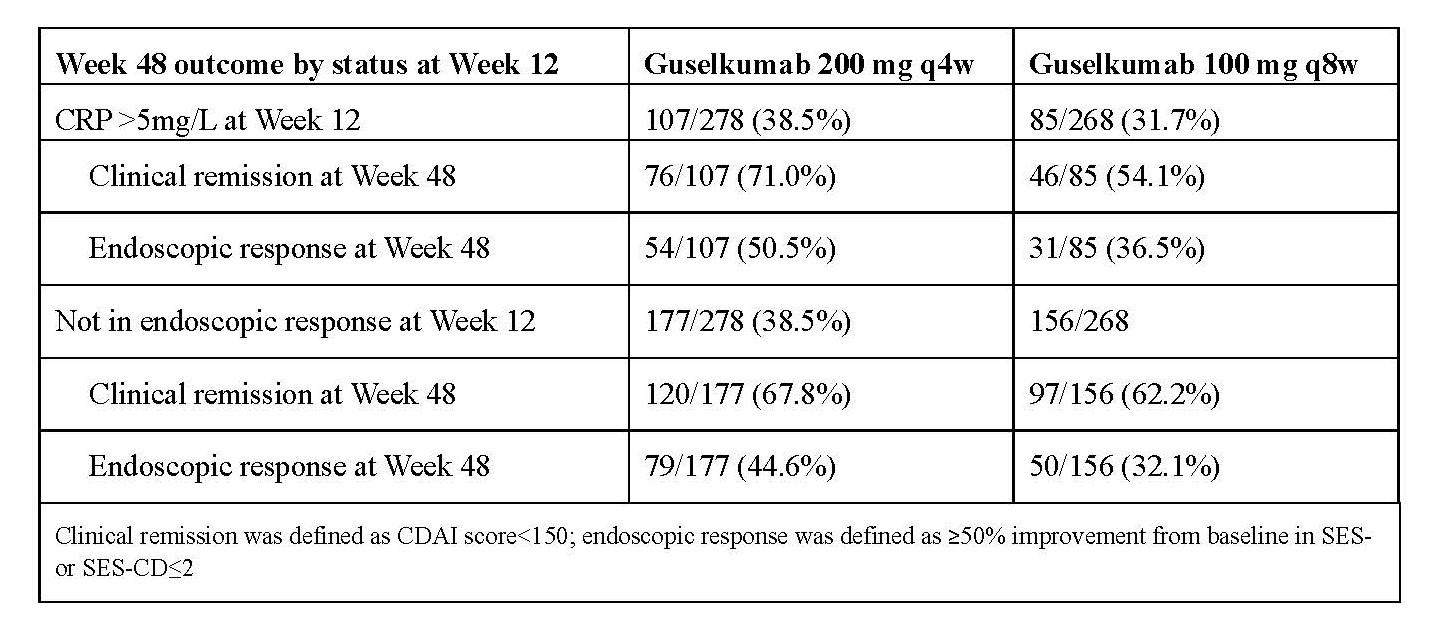
Anita Afzali, MD, MPH, MHCM, FACG1, Tadakazu Hisamatsu, MD, PhD2, David T. Rubin, MD3, Nat A. Terry, MD, PhD4, Rian Van Rampelbergh, MD5, Jacqueline Yee, MS6, Kitty Yeun Yi Wan, PhD7, Zijiang Yang, PhD4, Walter Reinisch, MD, PhD8, Bruce E. Sands, MD, MS, FACG9, Silvio Danese, MD, PhD10, Remo Panaccione, MD11 1University of Cincinnati College of Medicine, Cincinnati, OH; 2Kyorin University School of Medicine, Tokyo, Tokyo, Japan; 3University of Chicago Medicine Inflammatory Bowel Disease Center, Chicago, IL; 4Johnson & Johnson, Spring House, PA; 5Johnson & Johnson, Antwerp, Antwerpen, Belgium; 6Johnson & Johnson, Raritan, NJ; 7Johnson & Johnson, Allschwil, Schwyz, Switzerland; 8Medical University of Vienna, Spitalgasse, Wien, Austria; 9Icahn School of Medicine at Mount Sinai, New York, NY; 10IRCCS Ospedale San Raffaele and University Vita-Salute San Raffaele, Milan, Lombardia, Italy; 11University of Calgary, Calgary, AB, Canada Introduction: Guselkumab (GUS) intravenous (IV) induction followed by subcutaneous (SC) maintenance with 200mg every 4 weeks (q4w) or 100mg every 8 weeks (q8w) was effective in the GALAXI 2 & 3 phase 3 treat-through studies of participants (pts) with moderately to severely active CD, with similar efficacy between maintenance doses in the overall study populations. Here, we evaluated the efficacy of maintenance doses in subgroups of baseline disease activity and severity and inflammatory burden at Week (Wk)12 to determine if some pts may receive additional benefit from higher dose. Methods: Eligible pts had moderately to severely active CD (CDAI 220–450 and mean daily SF score >3 or AP score >1), SES-CD ≥6 (≥4 for isolated ileal disease), and inadequate response or intolerance to oral corticosteroids, AZA, 6-MP, MTX, or biologics. Pts were randomly assigned to GUS 200mg IV at Wk0, 4, & 8, followed by GUS 100mg SC q8w or 200mg SC q4w. The studies also included placebo and ustekinumab arms, but this analysis focused on differences between GUS maintenance doses. Wk48 endpoints included clinical remission (CDAI < 150) and endoscopic response (≥50% improvement in SES-CD or SES-CD≤2). Analyses of subgroups by baseline disease activity (CDAI >300 or SES-CD >12), and inflammatory burden (CRP >5mg/L) or endoscopic response at Wk12 were prespecified but not multiplicity controlled. Results: In the pooled GALAXI 2 & 3 dataset, pts with high disease activity at baseline (CDAI >300 or SES-CD >12) had numerically greater clinical and endoscopic outcomes at W48 with 200mg q4w compared with 100mg q8w (Fig). Pts with baseline CDAI ≤300 or SES-CD ≤12 had similar outcomes at W48 for both maintenance doses. Pts with greater inflammatory burden (CRP >5mg/L) at W12 or who were not in endoscopic response at W12 also had numerically greater clinical and endoscopic outcomes at W48 with the 200mg dose compared with the 100mg dose (Table). Pts with lower inflammatory burden (CRP ≤5mg/L) or who were in endoscopic response at Wk12 had similar clinical and endoscopic outcomes for both maintenance doses. Results for individual GALAXI 2 & 3 studies generally trended in the same direction for all subgroups. Discussion: Pts with high clinical or endoscopic disease severity at baseline, greater inflammatory burden after induction, or who had not achieved endoscopic response after induction showed greater clinical and endoscopic outcomes at Wk48 while receiving the 200mg SC q4w dose regimen compared with the 100mg SC q8w regimen.
Figure: Figure. Clinal and Endoscopic Outcomes for Participants with Baseline CDAI>300 and Participants with Baseline SES-CD>12
Figure: Table. Week 48 Outcomes by CRP and Endoscopic Response Status at Week 12
Anita Afzali, MD, MPH, MHCM, FACG1, Tadakazu Hisamatsu, MD, PhD2, David T. Rubin, MD3, Nat A. Terry, MD, PhD4, Rian Van Rampelbergh, MD5, Jacqueline Yee, MS6, Kitty Yeun Yi Wan, PhD7, Zijiang Yang, PhD4, Walter Reinisch, MD, PhD8, Bruce E. Sands, MD, MS, FACG9, Silvio Danese, MD, PhD10, Remo Panaccione, MD11, 68, Guselkumab Maintenance Dose Regimens in Patients With High Disease Activity and Severity: Subgroup Analysis of Participants With Moderately to Severely Active Crohn’s Disease in the GALAXI Phase 3 Studies, ACG 2025 Annual Scientific Meeting Abstracts. Phoenix, AZ: American College of Gastroenterology.