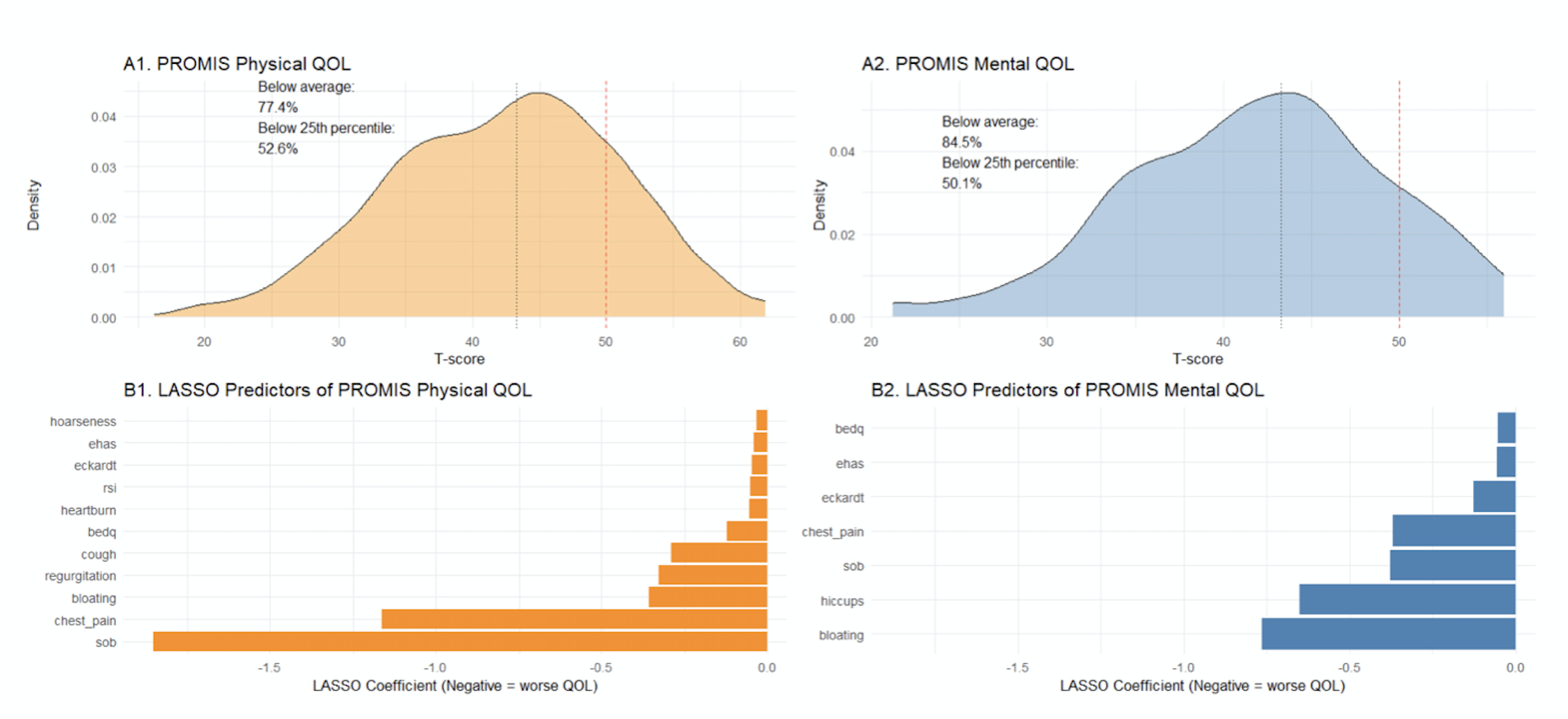
Ivana Radosavljevic, MD, Natalie David, BS, Shree Patel, MD, Anand Jain, MD Emory University School of Medicine, Atlanta, GA Introduction: Validated esophageal patient reported outcomes (PRO) emphasize the effect of bolus transit and acid exposure but may underrepresent the impact of other symptoms relevant to quality-of-life (QOL). This study aimed to identify which specific esophageal symptoms are most strongly associated with patient-reported QOL. Methods: We conducted a cross-sectional analysis of 832 patients referred to an esophageal specialty clinic who completed the Emory Assessment of SYmptoms in the Esophagus (EASY-E) Questionnaire, an 11-item tool rated on a Likert-scale (0 = none to 3 = horribly), along with validated PROs: GERDQ, RSI, BEDQ, Eckardt Score, and EHAS. PROMIS-10 Physical and Mental Health T-scores served as outcomes. Internal consistency was assessed by correlating EASY-E items with corresponding validated PROs. Associations with PROMIS scores were evaluated using Spearman correlations, multivariable linear regression, and LASSO regression. Results: Our prior clinic data has shown typical diagnoses: GERD (53%), EGJ outflow obstruction (22%), spastic/hypercontractile esophageal dysmotility (16%), achalasia (12%), and eosinophilic esophagitis (11%). In the present cohort, PROMIS scores were skewed left compared to national norms (mean Physical = 42.4, Mental = 41.5), with 77.4% and 84.5% of patients scoring below average, and over 50% below the 25th percentile (Figure 1A). Internal consistency analysis confirmed strong alignment between EASY-E items and validated PROs. In multivariable models (Table 1), shortness of breath, chest pain, and bloating were most strongly associated with worse physical QOL (linear regression adjusted R² = 0.30), while bloating, hiccups, and shortness of breath were less-strongly associated with diminished mental QOL (adjusted R² = 0.12). LASSO regression confirmed these individual symptoms as dominant predictors over aggregate PRO scores (Figure 1B). Discussion: In this esophageal cohort, specific symptom items often omitted or diluted in validated PROs—shortness of breath, bloating, chest pain, and hiccups— emerged as the strongest determinants of impaired QOL. These findings support comprehensive item-level symptom assessment in optimizing esophageal care. Future research may assess whether such comprehensive symptom assessments offer similar value in gastric conditions.
Figure: Figure 1. Distribution of PROMIS T-scores and Key Symptom Predictors: (A1–A2) Kernel density plots of PROMIS-10 Physical and Mental Health T-scores in the esophageal symptom cohort, with vertical lines indicating the population norm (T = 50, red dashed) and the 25th percentile threshold (T ≈ 43.3, black dotted). A majority of patients scored below average (77.4% for Physical, 84.5% for Mental) and over 50% fell below the 25th percentile. (B1–B2) LASSO regression coefficients identifying key symptom- and score-level predictors of impaired QOL. Shortness of breath, chest pain, bloating, and regurgitation were most predictive of physical QOL, while bloating, hiccups, and shortness of breath predominated for mental QOL. Coefficient directionality reflects strength and direction of association (more negative = worse QOL).
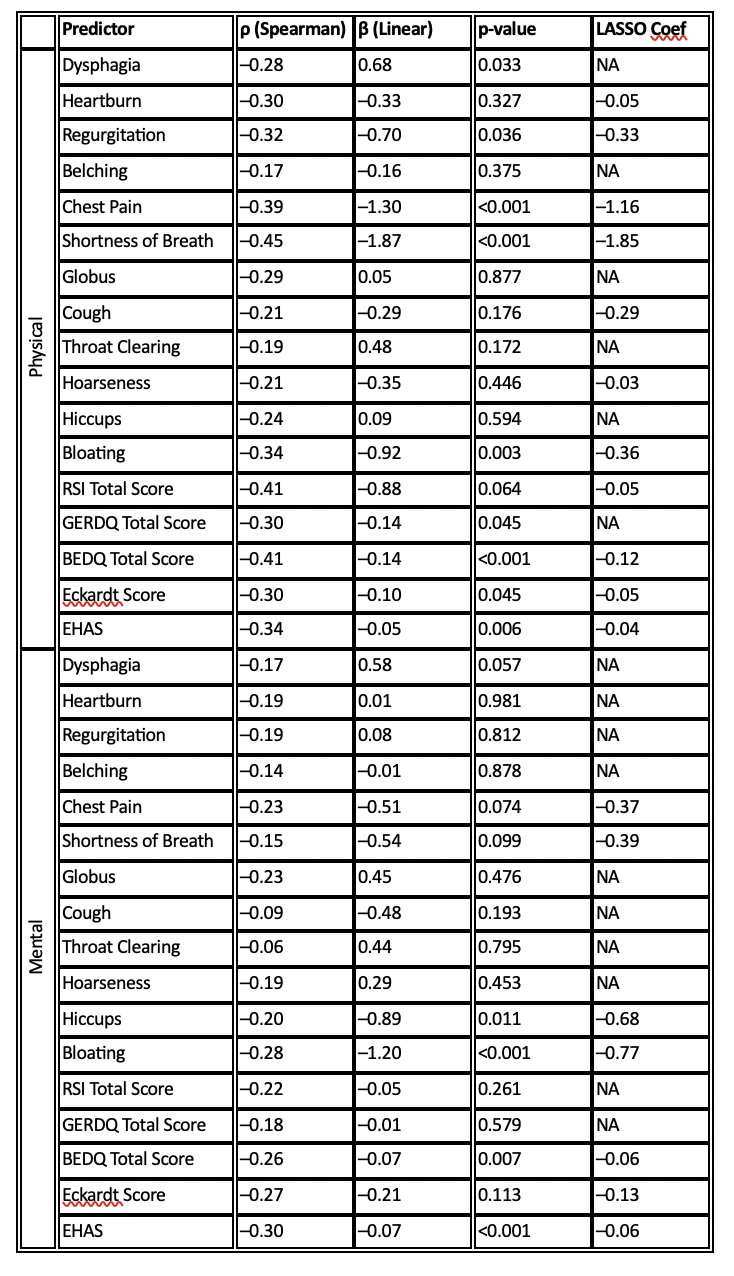
Figure: Table 1 summarizes the relationship between EASY-E symptom items and validated esophageal symptom scores with PROMIS Physical and Mental Health T-scores. Values shown include Spearman correlation coefficients (ρ), multivariable linear regression estimates (β), and LASSO regression coefficients. A LASSO coefficient of "NA" indicates that the predictor was not retained in the final model at the optimal penalty parameter λ. In multivariable models, chest pain, shortness of breath, bloating, and regurgitation were significantly associated with worse physical QOL (adjusted R² = 0.30). Bloating, hiccups, and shortness of breath were the most strongly associated with lower mental QOL across all analyses (adjusted R² = 0.12).
Disclosures: Ivana Radosavljevic indicated no relevant financial relationships. Natalie David indicated no relevant financial relationships. Shree Patel indicated no relevant financial relationships. Anand Jain indicated no relevant financial relationships.
Ivana Radosavljevic, MD, Natalie David, BS, Shree Patel, MD, Anand Jain, MD, 58, Symptoms Speak Louder Than Scores: Predicting Quality-of-Life Related to Esophageal Symptoms With EASY-E Questionnaire, ACG 2025 Annual Scientific Meeting Abstracts. Phoenix, AZ: American College of Gastroenterology.