31 - Comparative Efficacy of Tirzepatide vs. Semaglutide on Liver and Cardiovascular Related Outcomes in Patients with MASLD/MASH, Obesity, and Type 2 Diabetes Mellitus: A Real-World Cohort Study
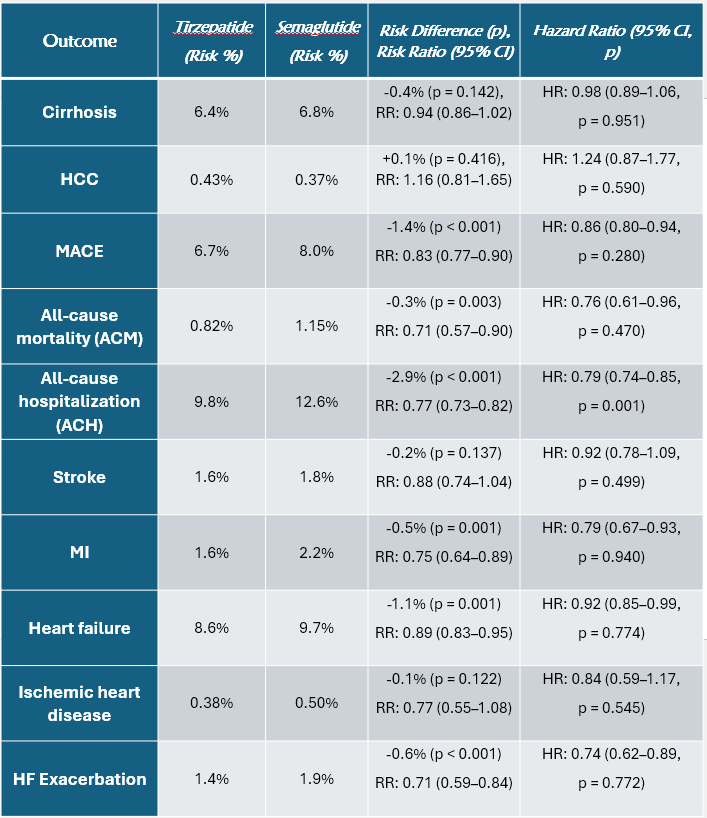
Basil Jalamneh, MD1, Mohamad-Noor Abu-Hammour, MD2, Islam Mohamed, MD1, Walid Hazem, DO3, Omar Sims, PhD4, Dian Jung Chiang, MD2 1Cleveland Clinic Foundation, Cleveland, OH; 2Cleveland Clinic, Cleveland, OH; 3University Hospitals, Cleveland, OH; 4Cleveland Clinic Foundation, Hoover, AL Introduction: Metabolic-associated steatotic liver disease (MASLD) and metabolic-associated steatohepatitis (MASH) commonly coexist with obesity and type 2 diabetes mellitus (T2DM). Tirzepatide, a dual glucose-dependent insulinotropic polypeptide (GIP) and glucagon-like peptide-1 (GLP-1) receptor agonist, and Semaglutide, a selective GLP-1 receptor agonist, have emerged as effective treatments addressing various metabolic derangements. This study compares real-world liver and cardiovascular outcomes of Tirzepatide and Semaglutide in patients with MASLD/MASH, obesity, and T2DM. Methods: Using the TriNetX global health research network, a retrospective, propensity score-matched analysis was conducted involving patients ≥18 years old with MASLD/MASH, obesity (BMI ≥30 kg/m²), and T2DM treated with Tirzepatide or Semaglutide (n=15,453 in each arm after propensity score matching). Matching included demographics, clinical characteristics, medications, and laboratory parameters. Outcomes assessed over three years included cirrhosis, hepatocellular carcinoma (HCC), major adverse cardiovascular events (MACE), all-cause mortality (ACM), and all-cause hospitalizations (ACH) with reported risk ratios (RR). HR and 95% CI were calculated using Kaplan Mayer curves. Results: Compared to Semaglutide, Tirzepatide was significantly associated with a lower risk of several outcomes: a 17% reduction in MACE (RR 0.83; 95% CI, 0.77–0.90), a 29% reduction in ACM (RR 0.71; 95% CI, 0.57–0.90), a 23% reduction in ACH (RR 0.77; 95% CI, 0.73–0.82), a 25% reduction in myocardial infarction (RR 0.75; 95% CI, 0.64–0.89), an 11% reduction in heart failure (RR 0.89; 95% CI, 0.83–0.95), and a 29% reduction in heart failure exacerbations (RR 0.71; 95% CI, 0.59–0.84). There were no statistically significant differences between Tirzepatide and Semaglutide in the risk of progression to cirrhosis (RR 0.94; 95% CI, 0.86–1.02) or the incidence of HCC (RR 1.16; 95% CI, 0.81–1.65). Discussion: In this large, propensity score-matched real-world cohort, Tirzepatide treatment was associated with lower risks of cardiovascular-related outcomes, all-cause mortality, and all-cause hospitalizations compared to Semaglutide in patients with MASLD/MASH, obesity, and T2DM. These findings highlight potential clinical advantages associated with dual GIP/GLP-1 agonism in managing complex metabolic conditions.
Figure: Table (1): Comparative Efficacy of Tirzepatide vs. Semaglutide (n = 15,453 per group; follow-up = 3 years). HR and 95% CI were calculated using KM curves was calculated using Kaplan-Mayer curves.
Disclosures: Basil Jalamneh indicated no relevant financial relationships. Mohamad-Noor Abu-Hammour indicated no relevant financial relationships. Islam Mohamed indicated no relevant financial relationships. Walid Hazem indicated no relevant financial relationships. Omar Sims indicated no relevant financial relationships. Dian Jung Chiang: Ipsen – Advisory Committee/Board Member.
Basil Jalamneh, MD1, Mohamad-Noor Abu-Hammour, MD2, Islam Mohamed, MD1, Walid Hazem, DO3, Omar Sims, PhD4, Dian Jung Chiang, MD2, 31, Comparative Efficacy of Tirzepatide vs. Semaglutide on Liver and Cardiovascular Related Outcomes in Patients with MASLD/MASH, Obesity, and Type 2 Diabetes Mellitus: A Real-World Cohort Study, ACG 2025 Annual Scientific Meeting Abstracts. Phoenix, AZ: American College of Gastroenterology.