Award: ACG Governors Award for Excellence in Clinical Research (Trainee)
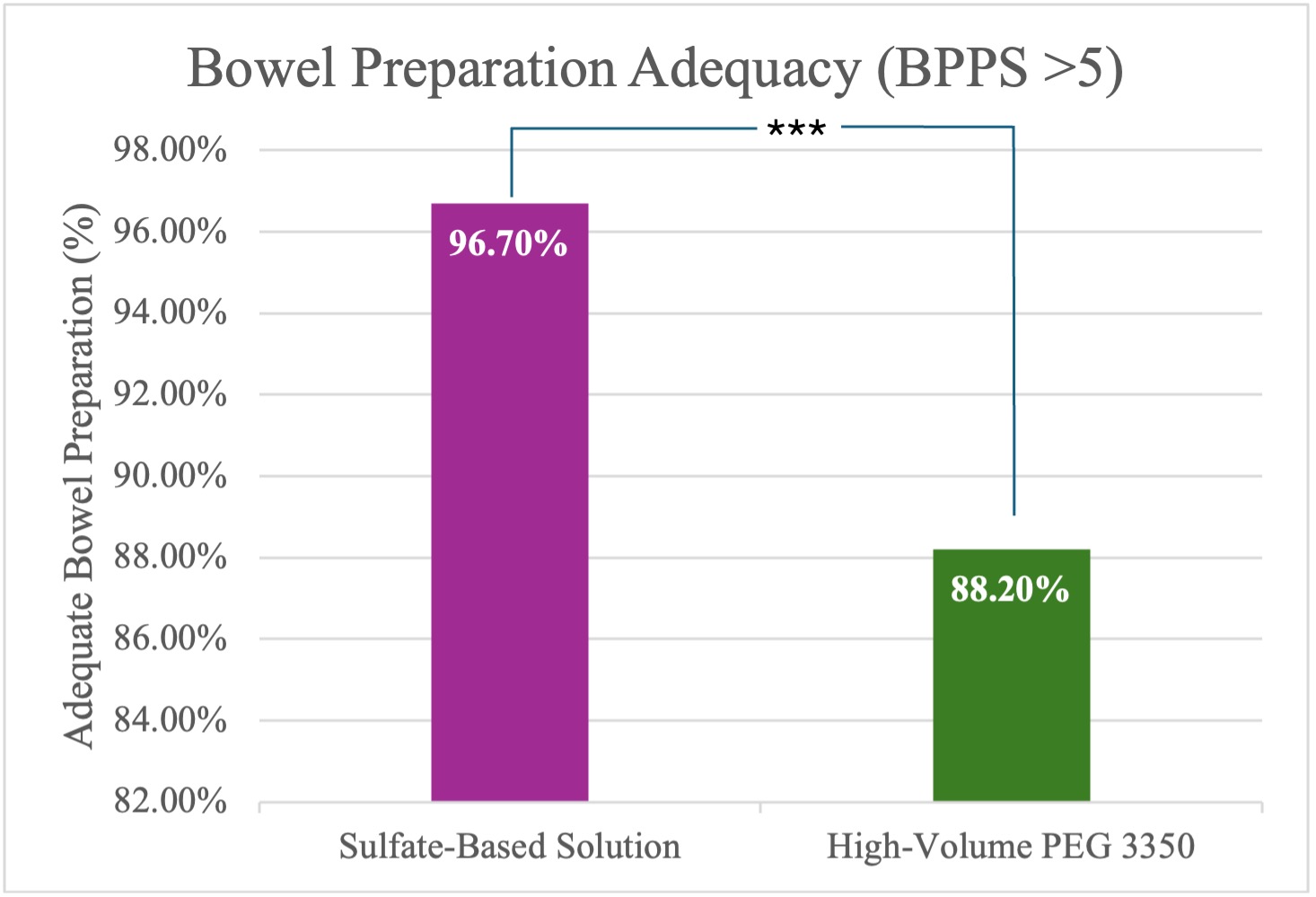
Benjamin Schwartz, MD, Brendan McQuillen, MD, MS, Michael Brown, MD Rush University Medical Center, Chicago, IL Introduction: High-quality bowel preparation is fundamental for successful colonoscopy as inadequate preparation increases the risk of suboptimal evaluation and need for repeat procedures. There are currently no strong recommendations for specific regimens, and choice of regimen is often decided by the endoscopist based on tolerability, comorbidities and cost. This study evaluated the performance and cost effectiveness of various regimens. Methods: This was a single-center, retrospective study examining patients undergoing colonoscopy at an academic center using deidentified data from documentation software. Bowel preparation regimens included sulfate-based solutions, high-volume polyethylene glycol (PEG) 3350 electrolyte solutions, low-volume PEG 3350 solutions, picosulfate-based solutions and sulfate-based tablets. Adequate bowel preparation was defined as a Boston Bowel Preparation Scale (BPPS) score >5. Multivariate logistic regression adjusting for age and gender was used to calculate adjusted odds ratios (aOR) for preparation adequacy. Bowel regimens with small sample sizes were analyzed descriptively. Results: 1,460 colonoscopies with preparation data were analyzed. 904 (61.9%) used sulfate-based solutions, 458 (31.4%) used high-volume PEG 3350 solutions. Adequate bowel preparation (BPPS >5) was significantly higher with sulfate-based solutions compared to high volume PEG 3350 solutions (96.7 vs 88.2%, p< 0.0001). Multivariate analysis adjusting for age and gender supported this association (aOR 3.71, 95% CI 2.33-5.91, p< 0.001). Older age was inversely associated with adequate preparation (aOR 0.97 per year, p=0.006), while gender was not significant. Other regimens with small sample sizes were also examined for preparation adequacy: low volume PEG 3350 solution (89.5%), picosulfate-based solution (97.6%), and sulfate-based tablets (95.8%). Discussion: Sulfate-based solution’s improved preparation adequacy would result in 85 fewer repeat colonoscopies per 1000 patients compared to high-volume PEG regimens. With an estimated cost of $2,200 per colonoscopy, sulfate-based solution yields over $150,000 in potential savings per 1,000 colonoscopies despite higher preparation cost. Patients are also spared the additional complications and costs associated with repeat procedures. This analysis suggests that sulfate-based solutions may be clinically and economically beneficial. Larger multicenter studies are needed to further evaluate this association.
Figure: Table 1: Bowel preparation adequacy by bowel prep regimen. Multivariate analysis also supported this trend
Disclosures: Benjamin Schwartz indicated no relevant financial relationships. Brendan McQuillen indicated no relevant financial relationships. Michael Brown indicated no relevant financial relationships.
Benjamin Schwartz, MD, Brendan McQuillen, MD, MS, Michael Brown, MD, 22, Sulfate-Based Regimens Improve Bowel Preparation Quality and Reduce Costs Compared to High-Volume PEG-Based Regimens: A Retrospective Analysis, ACG 2025 Annual Scientific Meeting Abstracts. Phoenix, AZ: American College of Gastroenterology.