30 - Outcomes of Liver and Cardiovascular Metabolic Diseases Among Lean vs Non-Lean Individuals With Dysfunction-Associated Steatotic Liver Disease: A Meta-Analysis
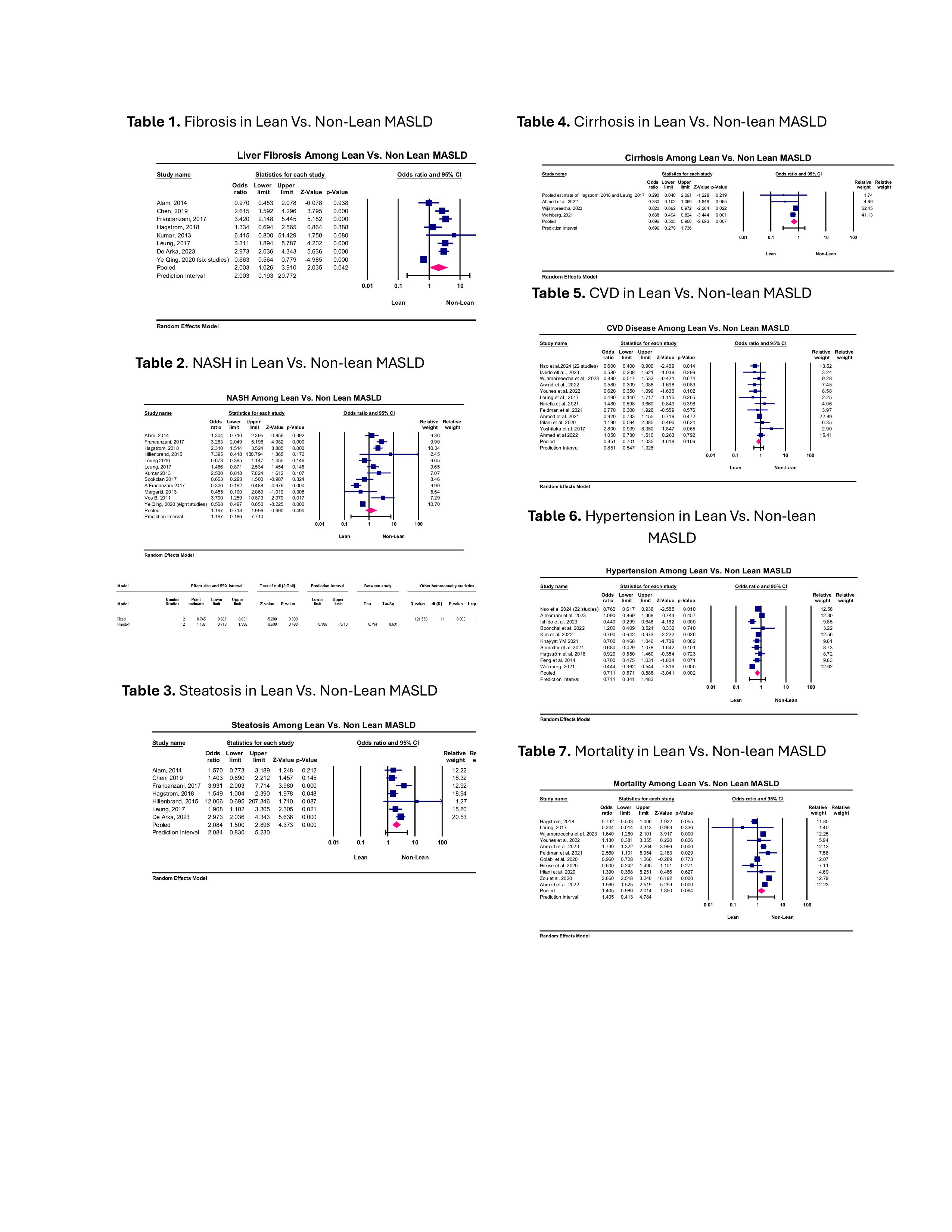
Mexan Mapouka, MD, MPH1, Nkafu Betchem. Ndemazie, MD, MPH, PhD2, Ijeoma Ikedum, MD, MSc3 1University of Maryland Capital Region Health, Largo, MD; 2Richmond University Medical Center, Staten Island, NY; 3Wellstar Kennestone Regional Medical Center, Atlanta, GA Introduction: Cardiovascular and Liver metabolic diseases are interconnected conditions, traditionally associated with obesity. However, both can occur in lean individuals, and the distinct clinical profiles and outcomes in this population remain poorly defined. Methods: We conducted a systematic review and meta-analysis of studies published in the past 20 years, retrieved from PubMed, Medline, Cochrane and Embase using the keywords for search "lean MASLD," "NAFLD in lean individuals," "non-obese fatty liver disease," "liver fibrosis," "steatosis," "NASH," "cardiovascular disease,". Eligible studies included clinical trials, meta-analyses, and systematic reviews comparing seven outcomes including liver fibrosis, steatosis, cirrhosis, non-alcoholic, non-Alcoholic Steatohepatitis, hypertension and cardiovascular disease between lean and non-lean MASLD individuals. We excluded preclinical studies. A random-effects model was applied to calculate pooled odds ratios (pORs) with 95% confidence intervals for the outcomes. Heterogeneity was assessed using Cochran's Q and I² statistics. All analyses were performed using Comprehensive Meta-Analysis software version 4.0. Results: A total of 31 studies comprising 10,735,550 participants were included. Most studies defined lean as BMI < 25 kg/m², with a lower cutoff of < 23 kg/m² in Asian populations. Non-lean MASLD individuals had higher odds of liver fibrosis (pOR = 2.0, 95% CI: 1.0–3.9, p = 0.04; I² = 82%), hepatic steatosis (pOR = 2.1, 95% CI: 1.5–2.9, p < 0.001; I² = 78%), and hypertension (pOR = 0.7, 95% CI: 0.6–0.9, p= 0.002, favoring lean MASLD; I² = 64%). Conversely, lean individuals had lower odds of cirrhosis (pOR = 0.7, 95% CI: 0.5–0.9, p = 0.007; I² = 57%). No statistically significant differences were found for NASH (pOR = 1.2, 95% CI: 0.7–2.0, p = 0.5; I² = 69%), cardiovascular disease (pOR = 0.9, 95% CI: 0.7–1.0, p = 0.1; I² = 71%), or mortality (pOR = 1.4, 95% CI: 1.0–2.0, p = 0.06; I² = 84%). Discussion: While non-lean individuals are more likely to develop fibrosis, steatosis, and hypertension, lean MASLD patients are not exempt from complications such as cirrhosis. There is a need to expand MASLD screening and risk stratification strategies beyond obesity metrics alone.
Figure: Tables and Figures of Pooled Effects Size and Forestplots Measuring the Seven (07) Cardiovasculr and Liver Outcomes Among Lean Vs. Non-Lean MASLD
Disclosures: Mexan Mapouka indicated no relevant financial relationships. Nkafu Ndemazie indicated no relevant financial relationships. Ijeoma Ikedum indicated no relevant financial relationships.
Mexan Mapouka, MD, MPH1, Nkafu Betchem. Ndemazie, MD, MPH, PhD2, Ijeoma Ikedum, MD, MSc3, 30, Outcomes of Liver and Cardiovascular Metabolic Diseases Among Lean vs Non-Lean Individuals With Dysfunction-Associated Steatotic Liver Disease: A Meta-Analysis, ACG 2025 Annual Scientific Meeting Abstracts. Phoenix, AZ: American College of Gastroenterology.