Session: Plenary Session 2A: Colon / IBD / Practice Management
21 - Factors Associated With Referral for Genetic Counseling in Patients With 10-99 Cumulative Colorectal Adenomas: A Single Center Retrospective Study
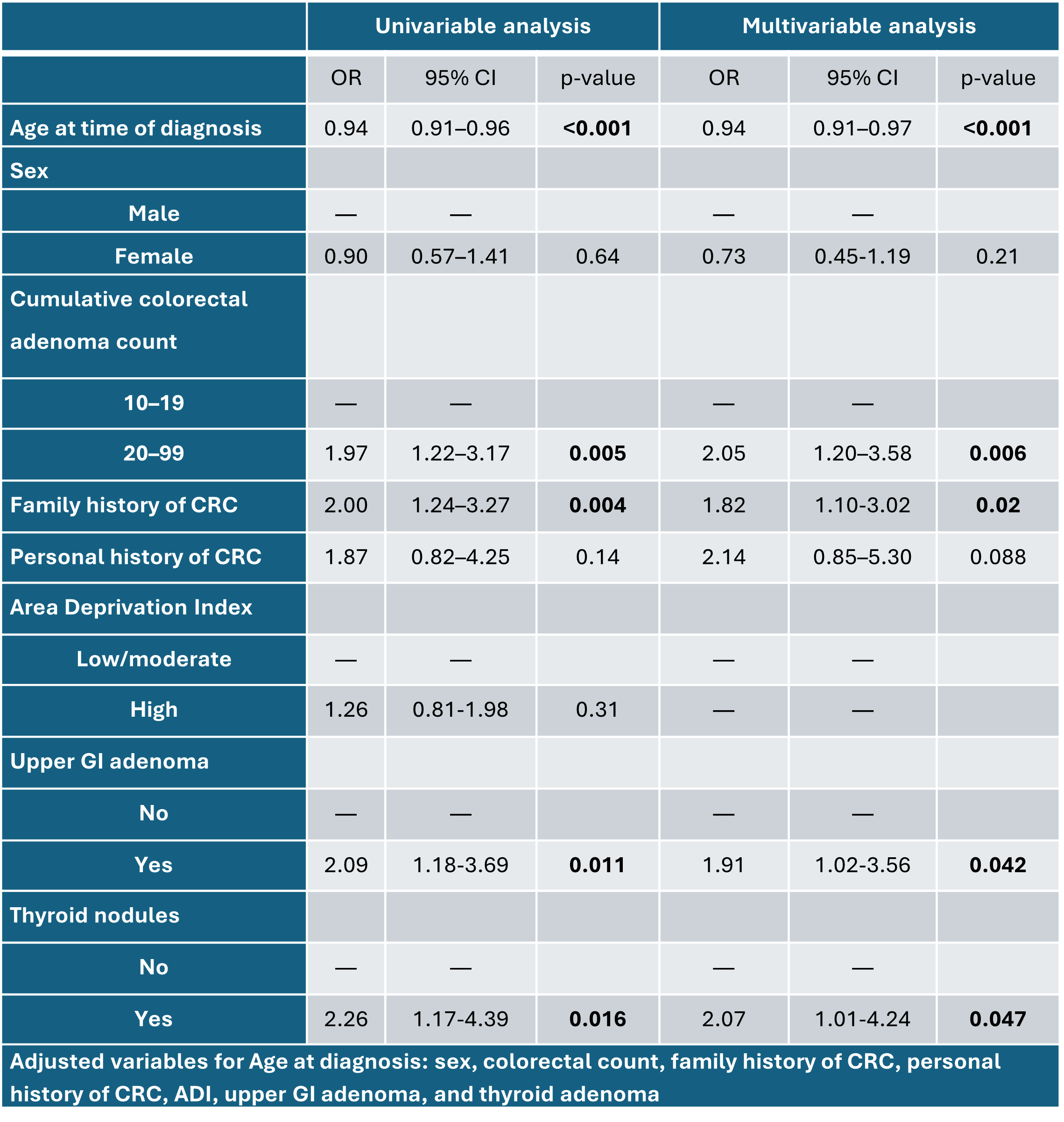
Ahmed N.. Mohamed, MD1, Moath Albliwi, MD2, Qijun Yang, MS3, Chabaklo Khodor, MD4, Islam Mohamed, MD2, Sara Shatnawy, MD5, Yara Shatnawi, MD2, Basil Jalamneh, MD2, Hazem Abosheaishaa, MD6, Carol A.. Burke, MD, MACG3, Carole Macaron, MD3 1Cleveland Clinic Foundation, South Euclid, OH; 2Cleveland Clinic Foundation, Cleveland, OH; 3Cleveland Clinic, Cleveland, OH; 4Cleveland Clinic Florida, Cleveland, OH; 5Jordan University of Science and Technology, Irbid, Irbid, Jordan; 6Mount Sinai West, Icahn School of Medicine at Mount Sinai, Queens, NY Introduction: The National Comprehensive Cancer Network (NCCN) recommends genetic testing for patients with ≥20 colorectal adenomas and considers testing for those with ≥10 adenomas. Despite these guidelines, referral rates remain low, and the factors influencing referral decisions in clinical practice are not well understood. This study aimed to identify clinicopathologic characteristics associated with referrals for genetic testing in this population. Methods: With IRB approval, we conducted a retrospective chart review using natural language processing to identify patients diagnosed with ≥10 cumulative colorectal adenomas between March 2009 and December 2023, based on data from the Cleveland Clinic’s pathology database. Patients with a known personal or family history of hereditary colorectal cancer (CRC) syndrome were excluded. Univariate and multivariable logistic regression analyses were performed to evaluate associations between demographics, clinical variables, and referral for genetic counseling. Results: A total of 385 patients with ≥10 cumulative colorectal adenomas were included. The median age at the time of oligoadenoma diagnosis was 74 years (IQR: 68-79). Of these, 118 (30.6%) were referred for genetic evaluation: 28 (23.7%) had 10-19 adenomas, and 90 (76.3%) had 20-99 adenomas. On univariable analysis, younger age at diagnosis (OR 0.94, p = 0.001), having 20–99 adenomas (OR 1.97, p = 0.005), a family history of colorectal cancer (OR 2.00, p = 0.004), upper gastrointestinal (GI) adenomas (OR 2.09, p = 0.011), and presence of thyroid nodules (OR 2.26, p = 0.016) were significantly associated with higher referral rates. In multivariable analysis, 20–99 adenomas (OR 2.04, p = 0.006), family history of CRC (OR 1.82, p = 0.020), upper GI adenomas (OR 1.91, p = 0.042), and thyroid nodules (OR 2.07, p = 0.047) remained independently associated with referral. Each one-year increase in age at diagnosis was associated with a 6% decrease in the odds of referral (OR 0.95, p < 0.001) (Table). Discussion: In our cohort, referral for genetic evaluation was twice as likely among those with 20–99 adenomas, younger age at diagnosis, a family history of CRC, and the presence of upper GI adenomas or thyroid nodules. However, the overall referral rate remained low (~30%), highlighting missed opportunities for genetic assessment in this high-risk population. These findings emphasize the need for greater provider awareness and consistent implementation of guideline-based referrals.
Figure: Table: Univariable and Multivariable Logistic Regression for Genetic Counseling Referral
Disclosures: Ahmed Mohamed indicated no relevant financial relationships. Moath Albliwi indicated no relevant financial relationships. Qijun Yang indicated no relevant financial relationships. Chabaklo Khodor indicated no relevant financial relationships. Islam Mohamed indicated no relevant financial relationships. Sara Shatnawy indicated no relevant financial relationships. Yara Shatnawi indicated no relevant financial relationships. Basil Jalamneh indicated no relevant financial relationships. Hazem Abosheaishaa indicated no relevant financial relationships. Carol Burke: emtora biosciences – Grant/Research Support. lumabridge – Consultant. myriad – Food and beverage. Natera – Food and beverage. Carole Macaron indicated no relevant financial relationships.
Ahmed N.. Mohamed, MD1, Moath Albliwi, MD2, Qijun Yang, MS3, Chabaklo Khodor, MD4, Islam Mohamed, MD2, Sara Shatnawy, MD5, Yara Shatnawi, MD2, Basil Jalamneh, MD2, Hazem Abosheaishaa, MD6, Carol A.. Burke, MD, MACG3, Carole Macaron, MD3, 21, Factors Associated With Referral for Genetic Counseling in Patients With 10-99 Cumulative Colorectal Adenomas: A Single Center Retrospective Study, ACG 2025 Annual Scientific Meeting Abstracts. Phoenix, AZ: American College of Gastroenterology.



.jpg "Ahmed N. Mohamed, MD (he/him/his) photo")